The essentials
- The Victorian School Building Authority runs the Building Blocks grants for kindergartens, including an Inclusion stream that funds playgrounds and safety surfacing.
- Buildings and Playgrounds grants have offered up to $200,000 (GST exclusive) per grant, with no co-contribution required.
- Equipment grants of up to $10,000 have covered moveable items such as soft fall mats, but not shade sails.
- For-profit organisations cannot apply for any Building Blocks stream.
- Rounds open and close. Check the current status, and prepare the documents before the round opens.
Where the money comes from
For kindergartens in Victoria, the main source of capital funding is the Victorian School Building Authority's Building Blocks program. It has several streams. Two matter most for play spaces:
- Building Blocks Inclusion funds upgrades to early childhood buildings and facilities, including playgrounds, and equipment, to provide safe and more inclusive environments for children of all abilities.
- Building Blocks Improvement funds upgrades, refurbishments and renovations to early learning facilities, and IT equipment. The VSBA lists its funding range as up to $750,000.
The VSBA says the 2025–26 State Budget included $15 million for the Building Blocks Improvement and Inclusion grants. Recipients of the 2025 rounds were announced on 18 February 2026. When we checked in November 2026, both streams were shown as closed, so watch the VSBA site for the next round.
Government schools have their own programs, managed through the VSBA's school funding pages, such as the Capital Works Fund for priority building projects.
Who can apply
The VSBA's Inclusion stream guidelines list the eligible applicants as a Victorian local council, a not-for-profit community organisation that is a legal entity (such as an incorporated association or cooperative), a Victorian government school, or a non-government school registered with the Victorian Registration and Qualifications Authority or the Victorian Catholic Education Authority.
The applicant must provide a funded kindergarten service at the time of application. For-profit organisations cannot apply for any Building Blocks stream. For the Improvement stream, the kindergarten must be, or will be, licensed to provide a funded free Three and Four-Year-Old Kindergarten program, and the guidelines tie the funding to the facility continuing to offer it after the project.
If the kindergarten sits on council or school land, the land owner's agreement is part of the application. Our chapter on who is responsible explains why that matters for surfacing too.
What the grants pay for, and what they do not
Under the Inclusion stream, the VSBA describes two grant types:
- Buildings and Playgrounds: up to $200,000 per grant (GST exclusive) for improvements to buildings and facilities, for fixed fittings and equipment. Applicants do not have to co-contribute. Its examples for outdoor spaces include upgrades to improve compliance, safety and accessibility, such as tactile paving, shade where there is no or limited shade, and easily accessible exits and clear pathways.
- Equipment: up to $10,000 per grant (GST exclusive) for moveable and accessible items. The list includes safety surfacing such as soft fall mats, ramps between play areas, gross motor equipment such as climbing frames and balancing boards, and sensory equipment. No co-contribution is required.
The exclusions are as important as the inclusions. The Equipment list excludes shade sails, reimbursement for equipment already bought, and ongoing maintenance costs. In other words, a grant can help replace a worn surface with a better one, but it will not pay for the routine top-up of tanbark. That stays in the operating budget; see inspections and records.
How applications are judged
For Buildings and Playgrounds grants, the VSBA's published merit criteria have been weighted as follows:
- 60%: how the works upgrade or maintain infrastructure so children of all abilities can take part in an inclusive kindergarten program, and support inclusive teaching;
- 20%: how the works support the seven principles of universal design;
- 10%: environmental sustainability;
- 10%: project readiness, including all required documents and a complete application.
That last tenth is the one a committee controls completely, and incomplete applications cannot be considered at all. The VSBA says it will not consider applications that lack required documents such as soil and asbestos reports, where required.
A surfacing project framed only as replacing old rubber scores less well than one that shows how the new surface lets a child using a wheelchair or walking frame reach the equipment. Questions about paths, edges, level changes and surfaces a wheelchair can cross are exactly what the inclusion criteria reward.
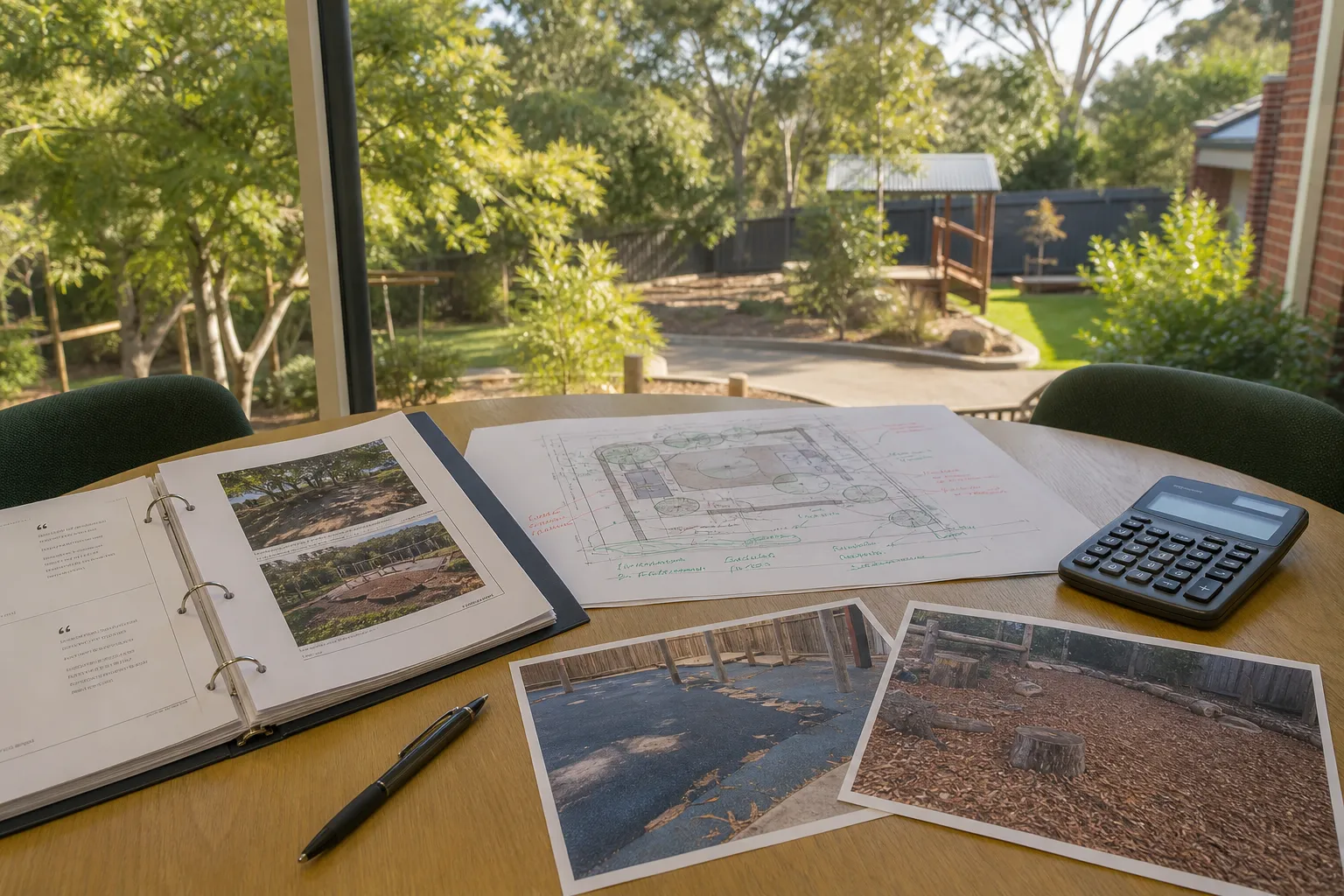
The folder to have ready
Rounds often open for a few weeks. Have these ready in advance:
- Quotes. For Buildings and Playgrounds, the VSBA asks for 2 quotes from 2 separate qualified professionals for projects under $200,000, or a quantity surveyor's report for larger projects. Equipment needs 1 supplier quote.
- A site plan marked up to show exactly where the works go, and a detailed design.
- Land owner documents: the lease or agreement, and for school sites the land use proposal the VSBA asks for.
- Reports: soil and asbestos reports where the works need them, and structural reports for roof work.
- Your own evidence: the inspection log, the last impact test report and photos showing the problem. They make the case for a priority upgrade far better than a description.
Our chapter on handover documents and supplier questions lists what to ask a surfacing supplier for at quote stage, and the same papers serve the grant application.
Other sources worth checking
- Your council. Councils own many kindergarten buildings and often fund or co-fund upgrades to their own facilities. Ask before you apply elsewhere.
- Shade programs. The VSBA's School Shade Sails Fund, a 2021 program for government schools, excluded shade over playgrounds, while noting that a separate Department of Health shade grants program treated playground shade as eligible. Check what is open now rather than relying on past rounds.
- Philanthropy and local business. Community foundations, service clubs and local businesses sometimes fund smaller items. Keep the same folder; it works for them too.
Questions committees ask
Can a private childcare centre apply for Building Blocks grants?
No. The VSBA states that for-profit organisations cannot apply for any Building Blocks stream.
Will a grant pay for new softfall under our equipment?
The Inclusion stream's Equipment grants have listed safety surfacing such as soft fall mats, and Buildings and Playgrounds grants fund fixed playground upgrades that improve safety and accessibility. Check the current guidelines when a round opens.
Do we have to put in our own money?
For the Inclusion stream's Buildings and Playgrounds and Equipment grants, the VSBA says applicants do not have to co-contribute.
When is the next round?
Rounds open and close on the VSBA's schedule. The 2025 recipients were announced in February 2026; check the VSBA Building Blocks pages for current dates.
Can a grant pay for shade sails?
Shade sails are excluded from the Inclusion stream's Equipment grants. Shade where there is little or none appears among the playground upgrade examples for Buildings and Playgrounds grants.
Sources for this chapter
- Victorian School Building Authority: Building Blocks Grants, Inclusion
- Victorian School Building Authority: Building Blocks Grants, Improvement
- Victorian School Building Authority: School funding programs
- Victorian School Building Authority: School Shade Sails Fund
- ACECQA: Providing appropriate outdoor space
- ACECQA: Guide to the NQF, Quality Area 3 (physical environment)
Tanbark is general information. Requirements change and every site is different: confirm with the regulator, your department or sector body, and a competent playground inspector.